Cumbria CVS Green blog No 31 – September 2026
September 24, 2026

 Welcome back to Cumbria CVS Green!
In our thirty-first blog post we welcome back Helen Attewell, Cumbria Sustainability Network Coordinator at Futureproof Cumbria. Helen explains how community energy can put local people at the heart of energy projects, with some local examples and details of free support available to develop your energy ideas.
If you have any suggestions about what you’d like to see in our regular updates, let us know! Contact us by emailing info@cumbriacvs.org.uk
You can find our what we’re doing to minimise our environmental impact and find details of organisations supporting positive environmental action in Cumbria on our Climate Commitment page here
Catch up on our other blog posts here
 Is community energy an opportunity tackle the climate crisis and for communities to ‘take back control’?
The Met Office stats are in, and as we hadn’t noticed for ourselves, we’ve had another record-breaking hot summer. The sad fact is that climate disasters like the recent Nepalese flooding tragedy will become more frequent without a rapid transition away from the use of fossil fuels. And as war continues to rage in the Ukraine, the Straits of Hormuz, and now the Bab-el-Mandeb (I didn’t even know there was such a thing until it was on the news!) our energy bills will continue to soar too if we remain dependent on oil and gas.
Electricity generated by renewables such as sunshine, water and heat in the earth is the obvious solution. We can do what we can in a private capacity to install solar panels on our houses etc., but another alternative could be communities working together in local neighbourhoods to establish their own energy schemes.
Community energy puts local people at the heart of energy projects, helping communities generate clean power, reduce energy costs, strengthen local resilience and keep more of the benefits of energy investment within the local area. We already have some successful examples of community hydro and solar projects across the county, such as Burneside Community Energy, which has installed 998.5kW of solar panels on the roofs of buildings belonging to James Cropper plc. This investment has generated funding for more installations, for example, on the roof of St Oswald’s CE Primary School, as well as for local charitable donations via a community benefit fund.
Technology keeps moving on, and there is government funding out there not just for wind turbines or solar arrays, but for new ideas such as developing heat networks using waste heat from industry or from groundwater.
The Government has pledged nearly £30m of funding for People’s Power projects, so that communities have the chance to build and control their own clean energy supply. This is part of a £1bn Great British Energy programme, which is hoped will eventually fund more than 1,000 People’s Power projects.
Futureproof Cumbria are working with the Centre for Sustainable Energy (CSE) to bring Community Energy GO support to communities across Cumbria, so that we can play our part too. This is also a gateway to obtain funding for feasibility studies and further development funds through the North West Net Zero Hub.
Through Community Energy GO, you can access free expert advice to help you develop your community energy idea – whether you’re just starting out or already have a project in development. Have a look at the webpage on the Futureproof Cumbria website and fill out an Expression of Interest form to take part in the project: Community Energy – Futureproof Cumbria
Come along to a webinar to find out more
Community Energy GO are running a series of events for community groups and organisations interested in exploring community energy in Cumbria. Some are national events and some are bespoke to Cumbria – please do sign up if you are interested:
COMMUNITY ENERGY GO
An introduction to the planning system
Wednesday 30th September, 1-2pm
FUTUREPROOF CUMBRIA
Community energy – getting started in Cumbria
Wednesday 21st October, 12.30-1.30pm
COMMUNITY ENERGY GO
New Community Energy Fund
TBC in October
COMMUNITY ENERGY GO
Engaging your community
Wednesday 4th November, 1-2pm
COMMUNITY ENERGY ENGLAND
Community Energy Conference, Liverpool
Tuesday 24th November
FUTUREPROOF CUMBRIA
Good governance – building a stronger community energy group
Thursday 26th November, 12.30-1.30pm

Seed Gathering Season 2026
Monday 21st September – Wednesday 21st October. Seed Gathering Season is an opportunity for us all to come together and gather seed from local trees and nurture them to become young saplings, which can be planted locally to benefit future generations.
Each Seed Gathering Season, the Tree Council runs free online talks supporting the campaign.
Cumbria Sustainability Network: championing climate concerns
Wednesday 30th September, Penrith. Hear the latest on climate and nature powers for Mayors, the National Emergency Briefing campaign, International Repair Day and community renewable energy — plus plenty of time to connect and swap ideas with others working for a more sustainable Cumbria.
Sustainability that makes business sense
Wednesday 7th October, online. Could sustainability strengthen your business as well as benefit the environment? Join Futureproof Cumbria in partnership with Cumbria Chamber of Commerce for a practical webinar to explore how sustainability can reduce costs, improve resilience, enhance your reputation and create opportunities for growth.
Get practical tips and real-life examples to help you identify where to start and focus your efforts.
Tackling Waste, Helping the Environment
Tuesday 13th October, Millom. A practical day exploring how communities can cut costs, reduce waste and take action for climate and nature.
Explore the environmental initiatives at Millom Network Centre, enjoy a surplus-food lunch, and watch The People’s Emergency Briefing.
Climate and Carbon Literacy training
Thursday 15th & Thursday 22nd October, online. Delve into the causes of climate change and what we can do about it. Boost understanding with Futureproof Cumbria’s in-depth, accredited online course.
Do you want to get your facts straight about the latest climate science? Develop an understanding of carbon footprints and build your knowledge of what we can all do, at home, in our communities and at work, to help restore the balance?
This training course provides a clear understanding of climate science, an awareness of carbon costs and the impacts of everyday activities. It will leave you with the ability and motivation to reduce emissions on an individual, community and organisational basis and is a great way to meet like minded people.
How to Start Your Own Repair Café
Saturday 17th October, Cockermouth. Could your community be the next to start a Repair Café?
Join us on International Repair Day to find out how. Cockermouth CAN will share its experience, alongside a panel of established Repair Cafés from across Cumbria. We’ll cover volunteers, costs, equipment, health and safety, promotion and building community, with plenty of time for questions and ideas.
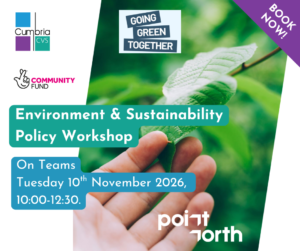 Environmental and sustainability policy workshop
Tuesday 10th November, online. This workshop will cover the importance of having an environmental and sustainability policy, how to write one, and how to implement effective action plans.
Find out more and book your place!
Climate Fresk
Tuesday 17th November, Kendal. Futureproof Cumbria’s Climate Fresk workshops offer a fun, engaging and collaborative way to explore the causes and impacts of climate change — and what we can do about it.
If you’d like to explore the climate crisis face-to-face, with other people, this could be just the thing for you. This session is free, so don’t delay, book now!

Tech Rescue: baking digital inclusion into community e-waste action
Good Things Foundation, alongside the University of Liverpool and Material Focus, have announced the launch of Tech Rescue, a three-year project designed to build a scalable and sustainable, community-led infrastructure for tech reuse across the UK. The project has received £1,497,312 from the Climate Action Fund, a long-term commitment from The National Lottery Community Fund, to support communities across the UK to act on climate change and involve more people in positive environmental action.
According to Material Focus research, there are over 188 million disused digital devices in UK homes, and the programme aims to repurpose 8,500 devices directly to households across the UK, helping to fix the digital divide through long term, sustainable action
The Linnean Society – Our Local Nature Grants
Amount available: £1,000
Deadline: Sunday 25th October
The scheme provides grants to support innovative projects, designed and led by young people in the UK, which aim to increase access to local natural spaces and improve understanding of local biodiversity.
Find out more about The Linnean Society – Our Local Nature Grants here
Applications open for next round of Greening Businesses Scheme
The scheme will help local businesses across Westmorland and Furness to understand how to reduce their carbon footprint and cut costs, promoting a more sustainable and environmentally friendly future for the area.
The continuation follows the success of two previous rounds of the scheme which have supported 20 local businesses with free carbon audits since 2025. The initiative once again offers businesses the opportunity to work with the Cumbria Business Environment Network (CBEN) Partnership.
Through this partnership, businesses can access a free carbon footprint assessment of their operations and activities from which they can develop strategies or implement measures to reduce carbon emissions and save costs.
Green Community Grants Programme
Amount available: up to £25,000
Deadline: opens Wednesday 30th September and closes Wednesday 21 October.
The funding is for organisations whose main aims and objectives fit with one of the following Fund’s themes:
- Contributing to nature recovery and responding to the climate emergency.
- Improving nature-rich spaces and access to them.
The grants can be used for a wider range of sustainable activities, including recycling, litter picking, beach cleans or sustainable transport.
As funding is generally oversubscribed, priority will be given to organisations:
- With an income between £10,000 and £250,000.
- That work in communities located in the top 15% of the Index of Multiple Deprivation.
- Whose main activities are focused on supporting marginalised groups. This could include, but is not limited to, disabled people, communities experiencing racial inequity, and LGBT+ people.
- Organisations whose objects or purpose within its governing document relate to habitat or species restoration/protection.
Groups can apply for no more than 25% of their annual income listed on their most recent set of signed accounts.
Find out more about Green Community Grants Programme here
The People’s Emergency Briefing
Experts in extreme weather, national security, food, health and economics came together at Westminster Hall to brief politicians on the climate and nature crisis.
Now a powerful film – The People’s Emergency Briefing – has been created to take the message further. You can watch the trailer here.
In just a few months, the film has been screened more than 2,000 times in communities and workplaces around the UK, bringing people together to discuss what we can do about it. Check the screenings map on the National Emergency Briefing website for an event near you, or register to host your own screening (full guidelines available).
Planting for Pollinators project receives award from DEFRA
Planting for Pollinators, a joint project between Westmorland and Furness Council and Cumbria Wildlife Trust, has been awarded The Bees’ Needs Champion Award by the Department for Environment, Food and Rural Affairs (DEFRA). The awards recognise and celebrate examples of exceptional initiatives undertaken to support pollinators.
Since the project’s launch in 2023, 22 sites have begun their transformation to species-rich lowland meadow or pollinator-friendly community gardens. From these 22 sites, a total of 4.2 hectares of pollinator-friendly habitats have been created across Westmorland and Furness, supporting local pollinator populations and transforming our green spaces into nature-rich spaces for residents to enjoy.
Over the last three years, Cumbria Wildlife Trust has been instrumental in supporting the project through the delivery of a programme of community-led pollinator themed events and training, equipping local communities, schools and town and parish councils who want to take action for nature with the knowledge and skills to manage and enjoy the sites.
Gardens Trust Community Grants
Amount available: up to £10,000
Deadline: Friday 16th October
Grants are available for charities and other voluntary organisations across the UK to deliver projects and activities that improve, enhance, and support historic designed landscapes.
Priority will be given to seed-funding/pump-priming for a sustainable activity, such as a restoration plan, Friends group set-up costs, research projects, or volunteer training schemes.
Projects that reflect the Gardens Trust’s priorities in conservation, knowledge sharing, and the encouragement of inclusive participation and enjoyment of historic designed landscapes are particularly welcomed.
Preference will be given to projects that will be completed within 18 months of the application.
Funding can be used to cover both capital and revenue projects.
Find out more about Gardens Trust Community Grants here
International Tree Foundation – UK Community Tree Planting Programme
Amount available: Grants are available for community woodlands/hedging projects that range from 100 – 10,000 trees planted per year, with a maximum price equivalent to £2.15 per tree (inclusive of tree protection and mulch).
In addition, these projects also receive two maintenance grants equivalent to £0.10 per tree, disbursed in the first and second summers after planting.
Deadline: Friday 11th December
The UK Community Tree Planting Programme supports projects run by community groups and voluntary organisations that engage communities in planting and caring for native species of trees.
The Programme supports community projects that will:
- Conserve, restore and protect indigenous trees and woodlands, forests, habitats and associated biodiversity.
- Support community engagement in tree planting to promote reforestation and to increase awareness of the importance of trees and forests to environmental and human well-being.
- Encourage social cohesion and inclusion.
Community-based organisations, such as a school, community group, social enterprise, non-governmental organisation, or parish council, can apply.
Find out more about International Tree Foundation – UK Community Tree Planting Programme here


