Flourishing Autistically: Perspectives from the Triple A team
October 22, 2026
In this guest blog, Susan Prior, Chief Executive Officer at Triple A (All About Autism), gives us a ‘flourishing focussed’ look at Autism, and why its important to understand what empowers autistic individuals to thrive and be accepted as their authentic selves.
Anyone who knows me well will roll their eyes if I mention lived-experience led research. This is something I tend to “bang on about” a bit. When I first started working at Triple A in 2022, I was fresh from completing an MSc thesis systematically reviewing lived-experience led Autism research focussing on positive mental wellbeing. I’d enrolled at Uni of Cumbria in 2018 as a (mature) undergraduate in applied psychology because I wanted to make sure I knew as much as I possibly could to help my Autistic son (then age 13) avoid the poor mental health outcomes so common for Autistic adults. My MSc thesis choice was a last-ditch attempt to read as much as I possibly could to support this goal, though I had acknowledged by then that there would never really be a point where I knew “enough”.
I’d had a hard time finding enough positively focussed literature to review at the time. The vast majority of the Autism research I’d sifted through was focussed on understanding negative mental health outcomes and suicidality. I wanted to understand what it took to be Autistic and keep thriving, but I could find very little literature even touching on understanding, promoting or increasing positive outcomes. In the end I had to widen my inclusion criteria to include research which, at the very least, included some content on reducing the likelihood of negative outcomes. After trying twenty differently worded database searches and sifting through a total of 633 papers, I was left with just twenty-four.
Fast forward four years, and I’m delighted to say it looks as though the Autism research picture is beginning to change. I was looking for papers to use in an “all team day” workshop, recently, and found that there’d been a conscious push towards something termed “Flourishing Focussed” Autism research. We were able to use some of this research to fuel workshop discussion on our team day. We explored together how Triple A’s services measure up against the things which research tells us can promote Autistic thriving. Then we brainstormed ways to do more of this. We had a really positive day together celebrating successes, shaping the future of Triple A and deciding what we want the wider community to know about us and what we do. So, when it was suggested that a member of the Triple A team might want to do a “think piece” about an aspect of Autism for the CVS newsletter, we decided we’d like to make this “flourishing focussed” too.
I asked some of my Autistic colleagues to share a little bit about what makes them happy, what helps them thrive and what it’s like when they are at their most content. Truthfully, as an (almost) entirely neurodivergent team, our individual wellbeing journeys can often feel a little bit like a “snakes and ladders” board, but we wanted to share some of our ladders with you here.
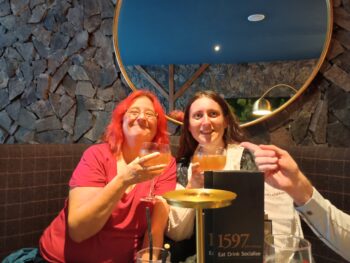
Tallis Andrews, Bookkeeper and Dungeon’s & Dragons group DM says “I am most content when I am doing something “childish”. Collecting and organising my Pokémon cards, building a Lego set, doing a puzzle, or colouring in. These types of activities make me feel calm and happy. As a late diagnosed autistic person, for a long time I thought that I “shouldn’t” be doing these types of activities because I was an adult, but they bring me a lot of joy. When I was in autistic burnout, I decided to try Dungeons & Dragons because I had always wanted to when I was younger, and it really helped me heal. I would encourage people to try out the games and activities that they used to enjoy when they were children and see how much it can help them as adults.”
(Photo: Tallis and Martha)
Chris Jerome, group facilitator says “I’m living my best life when I am out in nature working as a conservation volunteer. I find green and blue spaces very grounding and get an enormous sense of satisfaction from working with likeminded people helping to create habitat improvements and introducing new people to the wonderful natural history and wildlife in Cumbria.
I feel privileged to have been able to vaccinate badgers against bovine TB in our woodlands, work on the reintroduction of water voles in our catchment and survey white clawed crayfish and freshwater pearl mussels in our rivers. Over the last five years I have planted over 1k native trees. This is my proudest achievement and will be a legacy which will live on long after I have gone.”
Martha Rose, Navigator mentor, says “I feel at my best, and my most ‘me’ when I am accepted for who I am, in technicolour. Thriving looks like taking up space, gesticulating and using my hands in sweeping movements when I am talking animatedly. It involves not quietening myself, greying myself, dulling myself. Choosing not to blend into the background and instead to risk being seen for who I am, with colourful clothes and hair, is a sign that I am flourishing.
Crying when I need to cry, laughing and noticing when I am angry is part of thriving for me too – not shutting my emotions down or worrying about what is socially acceptable before even breathing the ‘wrong’ way, or gauging what is ‘appropriate’.
Being physically more active, swimming in the lake, walking, appreciating nature, crafting and being irreverent without fear of ostracism all follow from me being the me I was born to be, rather than the me society might expect me or want me to be.”
Tom Geary, training co-ordinator & lead trainer, says “To ‘Thrive Autistically’ I need some space, I need to be allowed to exist, not as the “masked” version of myself, but the authentic version. I need my hobbies, to pursue my interests and hyper-fixations without judgement, self-doubt or questions. I need space to be up late, researching a topic that many don’t care about to death, so that I can add it to my brain bank of useless facts or information that I can actually recall (this is situated next to the bank of important things that I should but don’t remember).
When I’m “Thriving Autistically” I’m calm, my mind feels like it has space to breathe, and I don’t feel irritable. I don’t feel like people are a threat to both my capacity and sanity, and I don’t feel like I have to push people away to create space between us. I feel happy, friendly, kind, and human.
When I’m thriving I can get things done, I can look after myself, and I can get on top of things, my mind functions as I imagine it is supposed to. I can pursue my interests and hobbies without judgement or self-doubt, I can unmask and talk to people as the ‘real’ me and communicate authentically. If I’m pointed at a task, work, or challenge that I have interest in, I can put my all into it and produce great results to the best of my ability, which makes me feel both competent and confident.”
Niamh Ryan, Youth Development Lead “I am at my most content when indulging in my interests and having something to invest my time into. I love exploring new places and doing new things (I am naturally very curious), particularly when I am in control and have the ability to set activities at my own pace. Being able to do things in my own time and having understanding from those around me is essential and allows me to be the best me I can be.”
The eagle eyed among you will have spotted a theme running through these accounts: feeling accepted as one’s authentic self. In Chris’ case this is through spending time with “like-minded” people, for the others it’s about feeling able to be authentic without fear of judgement. Research tells us that “masking” or camouflaging Autistic traits is correlated with increased risk of burnout and suicide for autistic people. Conversely, feeling accepted as yourself, feeling comfortable being yourself and feeling safe to “unmask” are all cited in “flourishing” or “thriving” focussed Autism research as an important factor in Autistic wellbeing, as is learning to accept yourself.
Hobbies and interests also feature heavily in Autistic accounts of thriving. Space and time to do these can help avoid, or recover from, burnout. They can help process emotions or thoughts and recharge depleted social batteries. Autistic people’s passions (often termed “special interests” or “hyper-focusses”) can be central to their sense of purpose too, as in Chris’ case and, given the right role, this can make some Autistic professionals exceptionally good at their job.
I’m going to end with a little update on my son, who is twenty-one now, thriving, and in his second year at university studying game development. Before he started his course last year, his Uni held a special “Autism Transition Day” where all the new Autistic students and their parents were invited to sit in a room four two hours to be told about all the mental health provision available at the uni, what to do if they felt suicidal or were struggling with self-harm, who to talk to “when” they felt anxious or depressed, where to go if they were bereaved or were involved in a “serious incident”… Only ten minutes of the two hours were given over to a talk by a member of the student union telling us about all the exciting clubs, societies, events and opportunities available to the thirty or so eager new students sat in the room. Then we were all whisked off on a tour that began in a room with the word “Counselling” on the wall in giant plastic letters. One year on, my son was excitedly telling me about his induction session for the “airsoft” society he’s decided to join with one of his friends. He told me they’d spent a couple of hours running round a room jumping over and behind tables and shouting “bang” at one another to practice. I asked him where all this happened he answered “do you remember the room where we had the doom and gloom seminar? It was in there”.
Keeping flourishing focussed doesn’t mean ignoring the bad times or that it isn’t important to make sure the right support is there when things aren’t so good, it just means we’d prefer to have higher hopes for the people we work with than “a bit less depressed” or “no longer suicidal”. We know we’ll never be able to get there with everyone, but we’re aiming for thriving not just surviving.

Susan Prior
Chief Executive Officer
Triple A (All About Autism)
I am also neurodivergent.


